
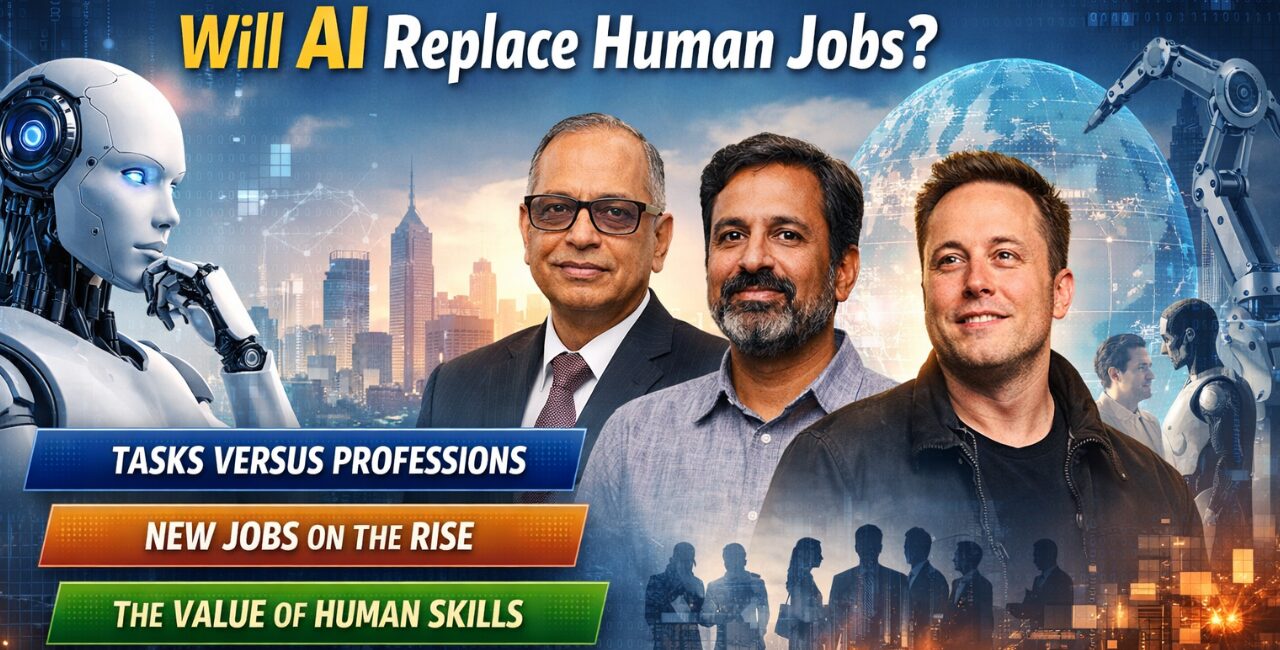
The rise of Artificial Intelligence (AI) has triggered one of the biggest global conversations of our time. Will AI take over human jobs? From boardrooms in Silicon Valley to IT corridors in India, the debate around AI replacing jobs, automation, and the future of work continues to grow stronger.
As businesses rapidly adopt AI tools, machine learning and automation technologies, professionals and students are asking a common question: Is my career safe in the age of AI?
The Global Debate: Is AI Replacing Human Jobs?
The concern about AI job displacement is not entirely new. Historically, every technological revolution from the Industrial Revolution to the Internet era has transformed the employment landscape.Today, however, the speed of AI automation is unprecedented.
Companies are leveraging:
- AI-powered tools
- Generative AI platforms
- Machine learning systems
- Robotic process automation (RPA)
- Data-driven decision making
This rapid transformation has sparked fears about AI replacing white-collar jobs, particularly in IT, finance, customer service, and content-related industries.
But is AI truly replacing humans or is it reshaping how we work?
AI Is a Tool, Not a Replacement
AI is just a tool. It cannot replicate the depth of human thinking, ethical reasoning, emotional intelligence, or creativity.
- AI cannot replace human creativity
- AI cannot replace critical thinking
- AI cannot replace leadership qualities
- AI cannot replace human empathy
Instead of fearing AI and automation, young professionals should focus on upskilling, reskilling, and mastering AI-driven technologies.
Those who learn to effectively use AI tools in IT, AI in software development, and AI in business operations will build stronger careers in the evolving digital economy.This aligns with a broader global trend. AI does not eliminate jobs entirely; it transforms job roles.
For example:
- Coders now use AI coding assistants
- Designers use AI-powered creative tools
- Marketers leverage AI analytics
- Recruiters use AI-driven screening systems
The message is clear: Adaptation is the key to survival in the AI era.
if individuals measure their value solely through income, designation, or intellectual superiority, AI disruption can create mental stress. However, many forms of meaningful work are not driven purely by money. Examples include:
- Teaching children
- Caring for the elderly
- Farming
- Forest conservation
- Performing religious rituals
- Practicing music for passion rather than profit
These roles are rooted in human connection, service, and purpose-driven work.
According to Vembu, such professions are unlikely to be fully replaced by AI because they are not transactional. They are deeply human. This introduces an important SEO-relevant theme: Human-centric careers in the AI age. As automation increases, society may witness a shift toward:
- Purpose-driven careers
- Community-oriented roles
- Sustainable livelihoods
- Local economy growth
- Meaning-based professions
In short, AI may replace repetitive tasks, but it cannot replace meaning.
With advancements in Artificial General Intelligence (AGI) and robotics, societies may move toward systems where people work out of interest rather than necessity. This raises new possibilities:
- Universal Basic Income (UBI)
- Reduced working hours
- Creative exploration
- Passion-based entrepreneurship
- Lifelong learning ecosystems
While this vision is still theoretical, it signals how dramatically AI transformation could reshape society.
Will AI Replace Jobs or Redefine Them?
To understand the impact of AI on employment, we must examine three key realities:
1. AI Replaces Tasks, Not Entire Professions
Most jobs consist of multiple tasks. AI tends to automate repetitive, data-heavy tasks rather than fully eliminating roles.
For example:
- AI can generate reports, but humans interpret strategy.
- AI can draft content, but humans refine messaging.
- AI can analyze patterns, but humans make ethical decisions.
2. New Jobs Are Emerging
The growth of AI careers includes roles such as:
- AI Engineers
- Machine Learning Specialists
- Data Scientists
- Prompt Engineers
- AI Ethics Consultants
- Automation Strategists
Search trends for AI jobs in India, AI career opportunities, and future jobs after AI have significantly increased indicating curiosity, not collapse.
3. Soft Skills Are Becoming More Valuable
As automation increases, uniquely human skills become premium assets:
- Emotional intelligence
- Leadership
- Communication
- Creativity
- Ethical reasoning
- Cultural understanding
These are skills AI cannot replicate authentically.
Impact of AI on Indian IT Sector
India, being a global IT powerhouse, faces both risk and opportunity.
On one hand:
- Entry-level coding jobs may reduce.
- Routine support roles may shrink.
On the other hand:
- AI integration services will expand.
- Data-driven consulting will grow.
- AI implementation projects will rise.
- Global demand for AI-skilled Indian professionals will increase.
The key takeaway for students and professionals is clear:
Upskill in AI, don’t compete against it.
What Should Students and Professionals Do Now?
Here is a practical roadmap for navigating the AI revolution:
✔ Learn AI Tools
Understand ChatGPT, automation software, AI coding tools, and analytics platforms.
✔ Develop Human Skills
Strengthen communication, leadership, creativity, and collaboration.
✔ Stay Updated
Follow AI trends, industry reports, and technology developments.
✔ Build a Hybrid Profile
Combine technical knowledge with domain expertise — for example, AI + Healthcare, AI + Finance, AI + Education.
✔ Focus on Purpose
Identify meaningful career paths beyond pure income motivation.
AI Cannot Replace Humanity
The debate on AI replacing jobs will continue. But the reality is nuanced.
- AI will automate tasks
- AI will transform industries
- AI will create new opportunities
- AI will challenge outdated skill sets
However,
- AI cannot replace empathy
- AI cannot replace purpose
- AI cannot replace human values
The future of work will not belong to those who resist AI — nor to those who rely entirely on it. It will belong to those who adapt, evolve, and remain deeply human. At its core, the conversation is not about machines replacing people. It is about people redefining their role in a technologically advanced world. And that future, while different remains full of opportunity.
